Google Ads costs keep rising. Organic rankings take time. Social media algorithms change every few months.
Don’t you think, how do successful WooCommerce stores keep growing?
The answer often lies in a channel that combines performance, scalability, and trust – affiliate marketing. Many of them use affiliate marketing.
Instead of paying upfront for clicks or impressions, affiliate marketing allows other people to promote your products and earn commissions only when they generate actual sales.
It’s a win-win situation. Affiliates earn money by recommending products they trust, while store owners gain new customers without taking on significant marketing risks.
And the numbers back it up.
According to industry research, more than 81% of brands operate affiliate programs, with affiliate marketing spending continuing to grow worldwide year after year.
Even more impressive, businesses report earning an average return of up to $15 for every $1 spent on affiliate marketing.
Whether you’re launching your first affiliate program or looking to improve an existing one, this guide will walk you through everything you need to know.
Let’s get started.
What Is WooCommerce Affiliate Marketing?
WooCommerce affiliate marketing is a performance-based marketing strategy where people promote your store using unique referral links.
An affiliate joins your program and receives a unique referral link. When someone clicks that link and makes a purchase, the affiliate earns a commission.
Unlike traditional advertising, you only pay when results are generated. This makes affiliate marketing one of the lowest-risk marketing channels available to ecommerce businesses.
The Four Key Players in Affiliate Marketing
Every affiliate program involves four participants. Take a look at the following affiliate marketing key players and what merchant and store owner can do :
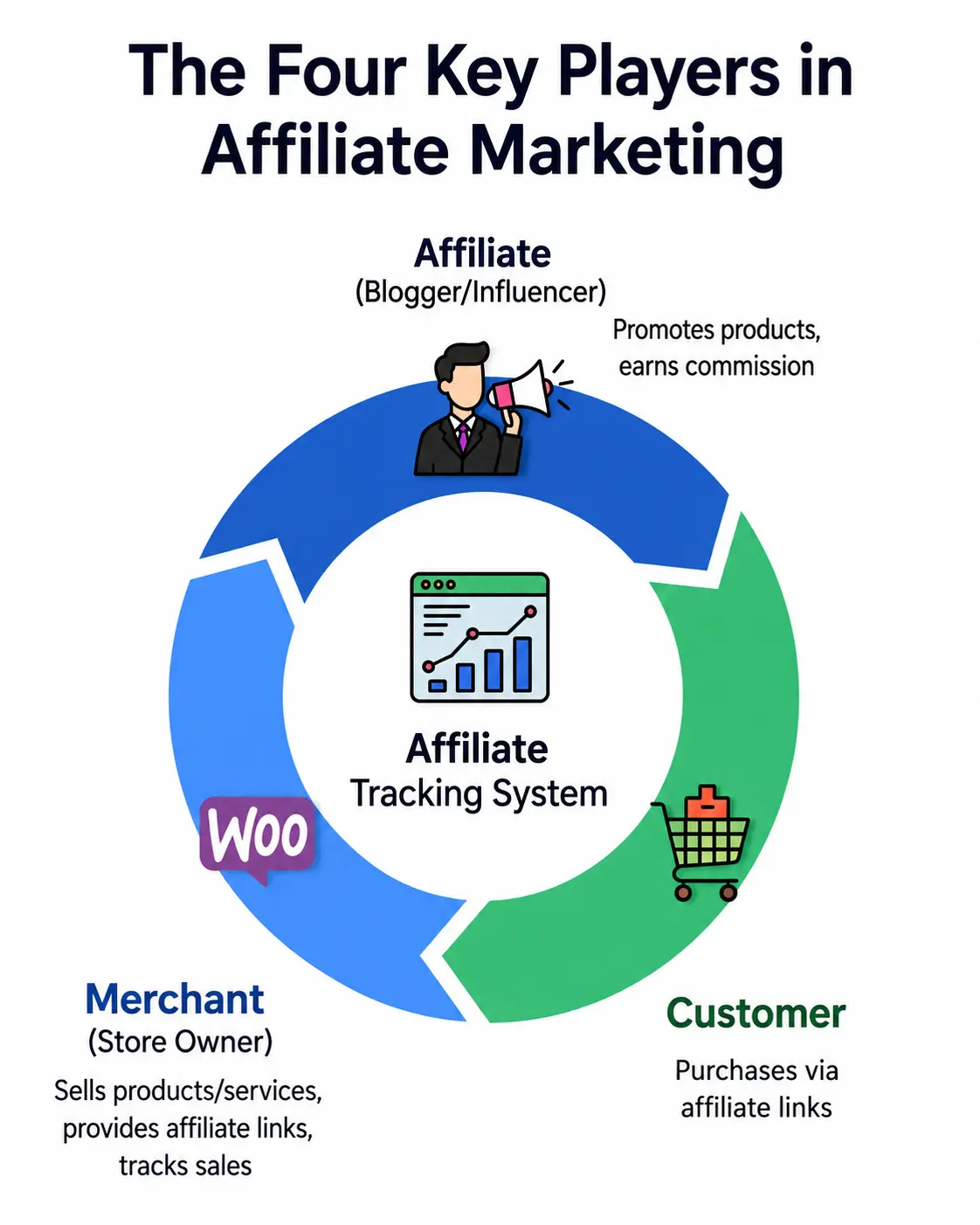
1. Merchant (Store Owner): The merchant owns the WooCommerce store and pays commissions. This is you, and you can decide:
- Commission rates
- Cookie duration
- Affiliate rules
- Payout schedules
2. Affiliate: Affiliates can be:
- Bloggers
- YouTubers
- Influencers
- Review websites
- Existing customers
- Industry experts
They promote your products to their audience.
3. Customer: Customers click affiliate links and purchase products from your store.
4. Affiliate Tracking System: Affiliate software tracks:
- Clicks
- Referrals
- Sales
- Commissions
- Payouts
Without proper tracking, affiliate marketing wouldn’t work.
Why WooCommerce Store Owners Should Invest in Affiliate Marketing
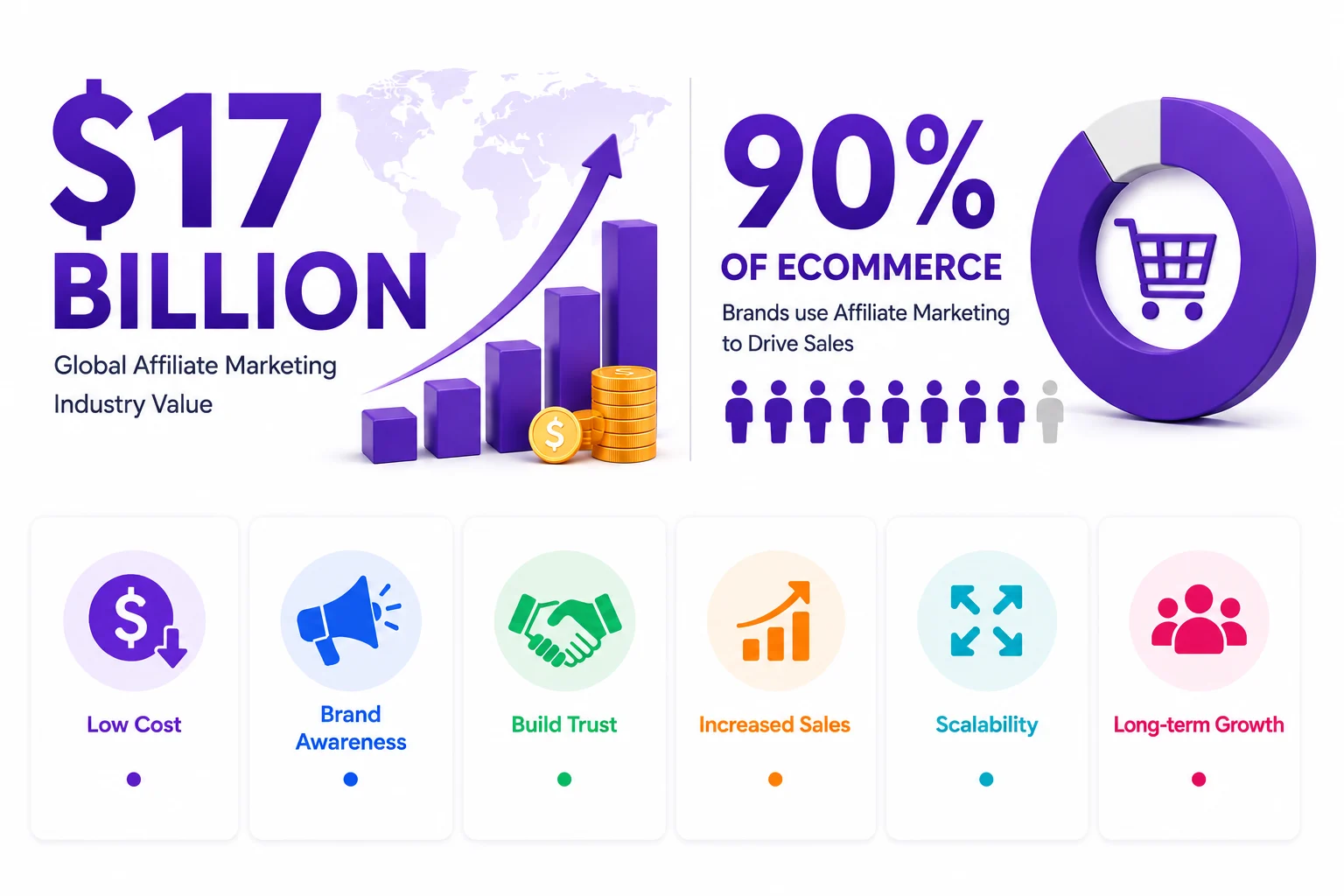
More WooCommerce store owners are investing in affiliate marketing because it delivers measurable results without requiring massive advertising budgets. The numbers make a compelling case on their own: the global affiliate marketing industry is on track to surpass $17 billion in 2026, and forecasts suggest over 90% of ecommerce businesses will run some form of affiliate program by the same year.
Key Benefits of Affiliate Marketing for WooCommerce
Lower Customer Acquisition Costs
Traditional advertising often requires significant upfront spending with no guarantee of results. Affiliate marketing is performance-based, meaning you only pay commissions when a sale is generated.
Increased Brand Exposure
Affiliates introduce your products to new audiences across blogs, social media platforms, YouTube channels, podcasts, and email newsletters.
The more affiliates promoting your products, the more visibility your brand receives.
Higher Trust and Credibility
People are more likely to purchase products recommended by creators, influencers, or experts they already trust. Affiliate recommendations often feel more authentic than traditional advertisements.
Scalable Growth
Unlike paid advertising, which often requires increased spending to generate more traffic, affiliate programs can continue growing as you recruit additional partners.
Better Return on Investment
Since commissions are only paid after successful conversions, affiliate marketing often produces a stronger ROI than many other digital marketing channels.
Popular Affiliate Marketing Models for WooCommerce Stores
Affiliate marketing isn’t just about commissions. WooCommerce store owners have several ways to run an affiliate program, from self-hosted plugins to third-party affiliate networks and different commission structures.
Let’s explore the most popular affiliate marketing models and how they work.
1. Plugin-Based Affiliate Programs
Many WooCommerce store owners prefer running their affiliate programs directly inside WordPress. This gives them complete control over commissions, affiliates, payouts, and customer data.
Easy to use & Popular plugins include:
- WC Affiliate (recommended)
- SliceWP
- YITH WooCommerce Affiliates
WC Affiliate Features
- Multi-level commissions (MLM-style affiliate network)
- Recurring commissions for subscription products
- Cross-domain cookie sharing
- Auto payouts via PayPal, Stripe, Wise & Payoneer
- Coupon-based affiliate tracking
- Custom affiliate registration forms
- Built-in shortlink generator
- Flexible commission rules (product or category)
- Affiliate banners and promotional assets
SliceWP Features
- Affiliate dashboard
- Referral tracking
- Custom commission rates
- Affiliate registration & approval
- Basic reports and payouts
YITH WooCommerce Affiliates Features
- WooCommerce integration
- Affiliate registration management
- Commission tracking
- Coupon attribution
- Performance reports
Why choose this model?
- Full ownership of affiliate data
- No network fees
- Easy WooCommerce integration
- Flexible commission rules
- Better profit margins
Best for: Most WooCommerce stores that want complete control over their affiliate programs.
2. Affiliate Network Platforms
Instead of managing affiliates yourself, you can join an established affiliate marketplace where publishers are already looking for products to promote.
Popular affiliate networks include:
ShareASale: One of the largest affiliate marketplaces with thousands of publishers and merchants.
Best for: Growing ecommerce brands.
CJ Affiliate: Formerly Commission Junction, CJ Affiliate connects brands with professional affiliates and media publishers.
Best for: Established businesses and larger stores.
Awin: A global affiliate network with partners across multiple countries and industries.
Best for: International brands.
Rakuten Advertising: A premium affiliate network used by many enterprise brands.
Best for: Large businesses.
Impact: Impact offers affiliate management, partnerships, and influencer marketing in one platform.
Best for: Brands looking for advanced partnership management.
10 Popular Commission Models for WooCommerce Affiliate Programs
Once you’ve decided how to run your program, you’ll need to choose how affiliates are rewarded.
1. Pay-Per-Sale (PPS)
Affiliates earn commissions only when a referred customer makes a purchase.
Best for: Ecommerce stores.
2. Percentage-Based Commission
Affiliates receive a percentage of each sale.
Example:
- 10% commission on a $200 order = $20 payout.
Best for: Most WooCommerce stores.
3. Flat-Rate Commission
Pay a fixed amount for every successful referral.
Example:
- $15 per sale regardless of order value.
Best for: Stores with similarly priced products.
4. Tiered Commission Model
Reward top-performing affiliates with higher commission rates.
Example:
- 10% for 1–10 sales
- 15% for 11–50 sales
- 20% for 50+ sales
Best for: Scaling affiliate programs.
5. Recurring Commission Model
Affiliates earn commissions every time a subscription renews.
Best for:
- Membership sites
- SaaS products
- Subscription businesses
6. Lifetime Commission Model
Affiliates continue earning from all future purchases made by their referrals.
Best for: Stores with repeat customers.
7. Multi-Tier Affiliate Marketing
Affiliates can recruit other affiliates and earn secondary commissions.
Best for: Communities and large affiliate programs.
8. Pay-Per-Lead (PPL)
Affiliates are rewarded when visitors complete actions like:
- Free trial signups
- Newsletter subscriptions
- Demo requests
Best for: SaaS and service businesses.
9. Pay-Per-Click (PPC)
Affiliates are paid for sending traffic rather than generating sales.
Best for: Brand awareness campaigns.
10. Performance Bonus Programs
Offer additional rewards when affiliates reach specific goals.
Examples include:
- Monthly bonuses
- Leaderboards
- Seasonal rewards
Best for: Increasing affiliate engagement.
Want to apply all these affiliate commission models in your WooCommerce store?
How to Launch a Profitable Affiliate Program for Your Store
Launching an affiliate program is easy. Launching one that consistently generates revenue is where strategy matters.
Many WooCommerce store owners install an affiliate plugin, invite a few affiliates, and expect sales to start rolling in. Unfortunately, it rarely works that way.
A profitable affiliate program requires the right structure, the right partners, and ongoing optimization. Here’s how to build an affiliate program that drives sustainable growth for your store.
1. Create a Clear Affiliate Program Structure
Before opening your affiliate program to applications, spend some time planning how it will work. A well-structured program not only makes management easier but also helps attract serious affiliates.
Think about the type of partners you want to work with, how much commission you’re willing to offer, and what actions affiliates should be rewarded for. Some stores pay commissions only on completed sales, while others also reward lead generation or free-trial signups.
It’s also important to decide how long referrals should be tracked. For example, if someone clicks an affiliate link today but makes a purchase two weeks later, should the affiliate still receive credit? Establishing these rules early creates transparency and prevents confusion later.
Step 2: Choose the Right Affiliate Plugin
Launching an affiliate program is easier than many store owners think. When choosing a plugin, look for:
- Referral tracking
- Affiliate dashboard
- Commission control
- Coupon tracking
- Payout system
- Reporting tools
For WooCommerce users who want everything in one place, WC Affiliate provides referral tracking, customizable commissions, affiliate registration forms, coupon tracking, shortlinks, payout management, and detailed analytics directly inside WordPress.
A particularly useful feature is its real-time affiliate dashboard, which allows both store owners and affiliates to monitor clicks, referrals, and earnings instantly.
If you want a detailed walkthrough, check out our guide: Launch a Complete WooCommerce Affiliate Program
3. Recruit Affiliates Who Match Your Audience

The success of your affiliate program largely depends on who promotes your products. Rather than accepting every applicant, focus on finding affiliates whose audience aligns with your target customers.
Industry bloggers, content creators, influencers, email marketers, and even loyal customers can become valuable partners. The goal is to work with people who already have credibility within your niche and can genuinely recommend your products.
To attract potential affiliates, promote your program through your website, email newsletters, social media channels, and community groups. A dedicated affiliate page explaining the benefits of joining can also help increase quality applications.
4. Give Affiliates the Resources They Need
Even the most enthusiastic affiliates can struggle to generate sales if they don’t have the right promotional materials.
Make their job easier by providing ready-to-use assets such as product images, banners, email templates, social media graphics, and promotional videos. Some businesses also offer exclusive coupon codes that affiliates can share with their audiences.
When affiliates spend less time creating marketing materials and more time promoting your products, everyone benefits.
5. Build Strong Relationships With Top Performers
Affiliate marketing works best when it’s treated as a partnership rather than a transaction.
Stay connected with your affiliates by sharing product updates, upcoming campaigns, seasonal offers, and performance insights. Consistent communication helps affiliates feel valued and keeps your brand top of mind.
Pay special attention to your highest-performing affiliates. Recognizing their contributions through bonuses, higher commission rates, or exclusive opportunities can encourage them to continue driving results for your business.
6. Monitor Results and Scale What Works
Once your affiliate program is running, regularly review performance data to identify what’s driving the best results.
Look at metrics such as referral traffic, conversion rates, revenue generated, and affiliate performance. These insights can reveal which partners, campaigns, or promotional strategies deserve more attention.
As your program matures, consider introducing tiered commissions, performance incentives, or VIP rewards to motivate affiliates and encourage long-term growth.
How to Choose the Best WooCommerce Affiliate Plugin
The success of your affiliate program depends heavily on the plugin you choose. While the best WooCommerce affiliate plugins offer similar core functionality, the right solution will help you manage affiliates easily, track referrals accurately, and more.
Before making a decision, focus on these key features:
Accurate Referral Tracking
Tracking is the foundation of every affiliate program. If referrals aren’t recorded correctly, affiliates may lose trust in your program. Look for a plugin that offers reliable referral tracking through affiliate links, cookies, and coupon codes.
Flexible Commission Rules
Not every product should have the same commission rate. A good affiliate plugin should allow you to set different commissions based on products, categories, affiliates, or performance levels. This flexibility helps protect your profit margins while rewarding top-performing partners.
Coupon-Based Affiliate Tracking
Many influencers and content creators prefer sharing discount codes instead of long referral URLs. Choosing a plugin that supports coupon attribution allows affiliates to earn commissions whenever customers use their unique coupon codes during checkout.
User-Friendly Affiliate Dashboard
Affiliates are more likely to stay active when they can easily monitor their performance. Look for a dashboard that displays clicks, conversions, commissions, and payout history in real time.
Automated Payout Management
Manually calculating and processing commissions becomes difficult as your program grows. A plugin with automated commission management and payout options can save significant administrative time.
Fraud Prevention Features
Affiliate fraud can lead to unnecessary commission payouts and inaccurate reporting. Features such as self-referral detection, suspicious activity monitoring, and manual approval workflows can help maintain program integrity.
Related Reading: Affiliate Fraud in WooCommerce: How to Spot It and Stop It (2026)
Easy WooCommerce Integration
The best affiliate plugins work seamlessly with WooCommerce without requiring complex setup or custom development. Installation, configuration, and day-to-day management should be straightforward, even for non-technical store owners.
Scalability for Future Growth
Your affiliate program may start with a handful of partners, but successful programs often grow to dozens or hundreds of affiliates. Choose a solution that can handle increased traffic, referrals, and affiliate management needs without performance issues.
Best Practices for Affiliate Marketing Success
Running an affiliate program is only the beginning. To maximize results, focus on building long-term relationships with your affiliates.
Recruit the Right Partners: Quality is more important than quantity. A handful of highly engaged affiliates can often outperform hundreds of inactive ones.
Offer Competitive Commissions: Research what competitors are offering and create a commission structure that motivates affiliates while remaining profitable.
Communicate Regularly: Keep affiliates informed about product launches, seasonal promotions, and special campaigns.
Reward Top Performers: Consider offering performance bonuses, higher commission tiers, or exclusive incentives to your most successful affiliates.
Continuously Improve Your Program: Review performance data regularly and make adjustments based on what drives the best results.
Final Thoughts
Affiliate marketing remains one of the most sustainable growth channels available to WooCommerce store owners.
The biggest advantage isn’t just generating more sales-it’s building a network of people who actively promote your products because they benefit when your business succeeds.
Start small. Recruit a handful of quality affiliates. Focus on accurate tracking, clear communication, and fair commissions.
If managing referrals, payouts, reporting, and affiliate onboarding feels overwhelming, a dedicated WooCommerce solution like WC Affiliate can simplify the entire process while keeping everything inside your WordPress dashboard.
The sooner you launch, the sooner your affiliates can start helping you grow.
Grow Your Affiliate Business with WC Affiliate
Get practical tips, useful guides, product updates.
Frequently Asked Questions
Yes, a plugin helps you track referrals, manage commissions, and automate payouts efficiently.
It depends on your profit margins, but most WooCommerce stores offer between 5%–30%.
Yes, customer referral programs are one of the most effective affiliate models.
In many cases yes, because you only pay for actual conversions instead of clicks or impressions.
You can recruit through your website, social media, email lists, and by reaching out to influencers and bloggers in your niche.