Affiliate marketing is one of the few ways to grow sales, where you only pay after a sale has occurred. You give other people a link to your products. They promote it to their audience. When someone buys, you pay them a small commission. If nobody buys, you pay nothing.
For a small business, that math is hard to beat. You are not gambling on ad spend and hoping it works. You are handing part of your marketing to people who only get paid when they bring you real customers.
This guide covers how affiliate marketing works for a small business and when it makes sense. It shows you what commission to offer and how to set up a program on your own site. No fluff. Just the parts that actually move revenue.
What is affiliate marketing for small business?
Affiliate marketing is a pay-for-performance arrangement. You partner with people (your affiliates) who promote your products using a unique tracking link. When a sale comes through that link, the affiliate earns an agreed commission.
Think of it as a commission-only sales team that you never have to put on payroll. A blogger reviews your product. A customer shares their link in a Facebook group. A niche YouTuber mentions you in a video. Each of them has a tracking link, so you always know who sent the sale.
The key difference from paid ads is the risk. With ads, you pay for clicks and impressions before you know if they convert. With affiliates, you pay a percentage of a sale that has already happened. Your cost is tied directly to your revenue.
Is affiliate marketing worth it for a small business?
For most small stores, yes. The model fits a small budget because the cost only shows up when money is already coming in. You are not fronting cash for a campaign that might flop.
The wider market backs this up. Affiliate marketing drives roughly 16% of all e-commerce sales in the US and Canada. The global industry is projected to grow past $30 billion by the early 2030s. More than 80% of brands now run some form of affiliate or partner program. This is not a fringe tactic anymore.
There are three practical reasons it works well for small businesses:
- You only pay for results. No sale, no cost. That protects your cash flow in a way that ads and sponsorships do not.
- You borrow other people’s trust. When a creator your audience already follows recommends you, that recommendation carries weight your own ads cannot buy. People trust a person more than a banner.
- You reach audiences you could not reach alone. Every affiliate brings their own followers, email list, or community. You tap into pockets of buyers you would never find on your own.
That said, affiliate marketing is not a fit for everyone. It works best if you have a product people are happy to recommend, a decent profit margin to share, and a bit of patience. If your margins are razor-thin or your product is a hard sell that needs heavy hand-holding, put your energy elsewhere first. Affiliate marketing amplifies a product people already like. It does not fix one, they do not.
Affiliate, referral, and influencer marketing are not the same thing

People mix these up, and it leads to bad decisions. Here is the clean version.
Affiliate marketing is ongoing. Affiliates promote you again and again, and they earn a commission on every sale they drive. They are usually creators, bloggers, or people with an audience.
Referral marketing is your existing customers sending friends your way, often for a reward like a discount or store credit. It is powered by happy customers, not creators, and the reward is usually smaller and one-off.
Influencer marketing usually means paying a flat fee for a post or campaign, up front, with no direct link between what you pay and what you sell. You pay for reach, not for results.
Affiliate marketing for small businesses gives you the best of both worlds. You get the reach of influencers without the up-front fee, and you get performance-based payouts like referrals but at a bigger scale.
How to start an affiliate program for your small business
You can launch a working program in an afternoon. The trick is getting the pieces right so you are not fixing them later. Here are the steps in order.
1. Set one clear goal
Decide what the program is for before you build it. More first-time customers? More repeat orders? A push on one product line? Your goal shapes your commission rate and who you recruit.
Keep it simple to start. A goal like “get 20 active affiliates and $2,000 in affiliate-driven sales in 90 days” is enough. You can raise the bar once you see what works.
2. Choose your commission structure
This is the decision people overthink. You have two basic options, and you can mix them.
- Percentage commission means you pay a share of each sale, for example 15%. It scales with order value, so affiliates earn more when they sell more. This is the most common choice for physical and digital products.
- Flat-rate commission means you pay a fixed amount per sale, for example $10. It is easy to explain and works well when your prices are consistent.
So what number should you pick? For physical products with real production costs, 5% to 15% is normal. For digital products and courses, where the margin is high, 20% to 40% is common and sometimes higher. The right rate is the highest one you can pay and still make a healthy profit after the commission. Affiliates promote the programs that pay them well, so do not be stingy if your margins allow more.
One more tip. Decide early if you pay on the first sale only or on repeat purchases too, and if the commission applies to the whole order or just the referred product. Write it down so there is no confusion later.
3. Pick your affiliate software
For your small business Affiliate marketing, you have two paths here.
An affiliate network is a big marketplace of affiliates. It handles the tech and gives you access to affiliates. In return, it takes a cut, adds fees, and puts you in a pool competing with other brands. You also do not fully own the affiliate relationship.
A self-hosted affiliate plugin runs on your own website. You keep 100% of the relationship, pay no per-sale platform fee, and control everything from commissions to payouts. For a small business, this is almost always the better long-term choice. You are not renting your program from a middleman.
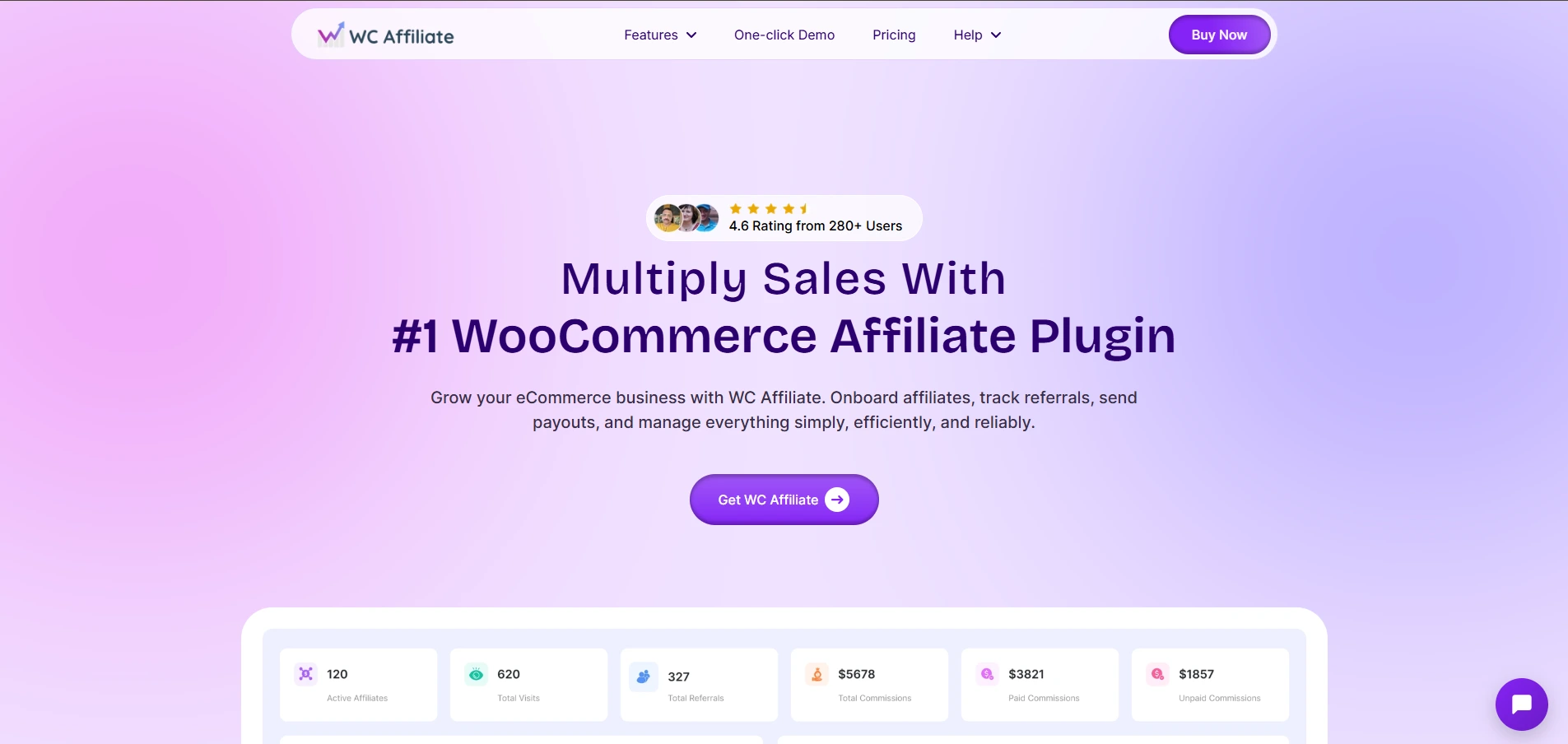
If you run your store on WooCommerce, a plugin like WC Affiliate plugs straight into your existing checkout, so every sale is tracked automatically without extra setup. It is built natively for WooCommerce, adds no cap on affiliates, and runs on a one-time license instead of a fee that grows every year.
Ready to set this up? Add WC Affiliate to your WooCommerce store and start for free.
4. Set your program terms
Write a short, plain-language agreement. Cover the commission rate and the cookie duration, meaning how long after a click a sale still counts (30 to 60 days is standard). Spell out which promotion methods are allowed and which are banned, like bidding on your brand name in ads or spamming. Clear rules up front prevent messy disputes later.
5. Recruit your first affiliates
This is where most programs stall. Do not wait for affiliates to find you. Go get them. If you want a deeper playbook, here are 11 proven ways to get more affiliates for a WooCommerce store.
Start with your own customers. The people who already love your product are your best affiliates. Email your happy buyers and invite them in.
Then look at your niche. Search for bloggers, YouTubers, and newsletter writers who already talk about products like yours. Reach out with a short, specific message. Tell them what you sell, your commission, and why their audience would care.
Make signing up easy. Add a signup page to your site and link to it in your footer, your order confirmation emails, and your social bios. Make it easy for people to raise their hand.
6. Give affiliates what they need to sell
An affiliate who has to make their own graphics will promote you less. Hand them the tools. Provide ready-made banners, product images, sample social captions, and their tracking links in one place. The less work you make it, the more they will post.
7. Track sales and pay on time
Nothing kills a program faster than late or missing payments. Set a clear payout schedule (monthly is common) and a minimum threshold if you want one. Then pay reliably. Affiliates talk to each other, and a reputation for paying on time is one of your best recruiting tools.
8. Review and improve
Once sales start coming in, watch which affiliates drive real revenue and which sit idle. Reward your top performers with a higher rate or a bonus. Check in with the quiet ones and offer help. A program is a relationship, not a set-and-forget switch. If you are not sure which numbers to track, start with the affiliate marketing metrics that actually matter.
How much does an affiliate program cost to run?
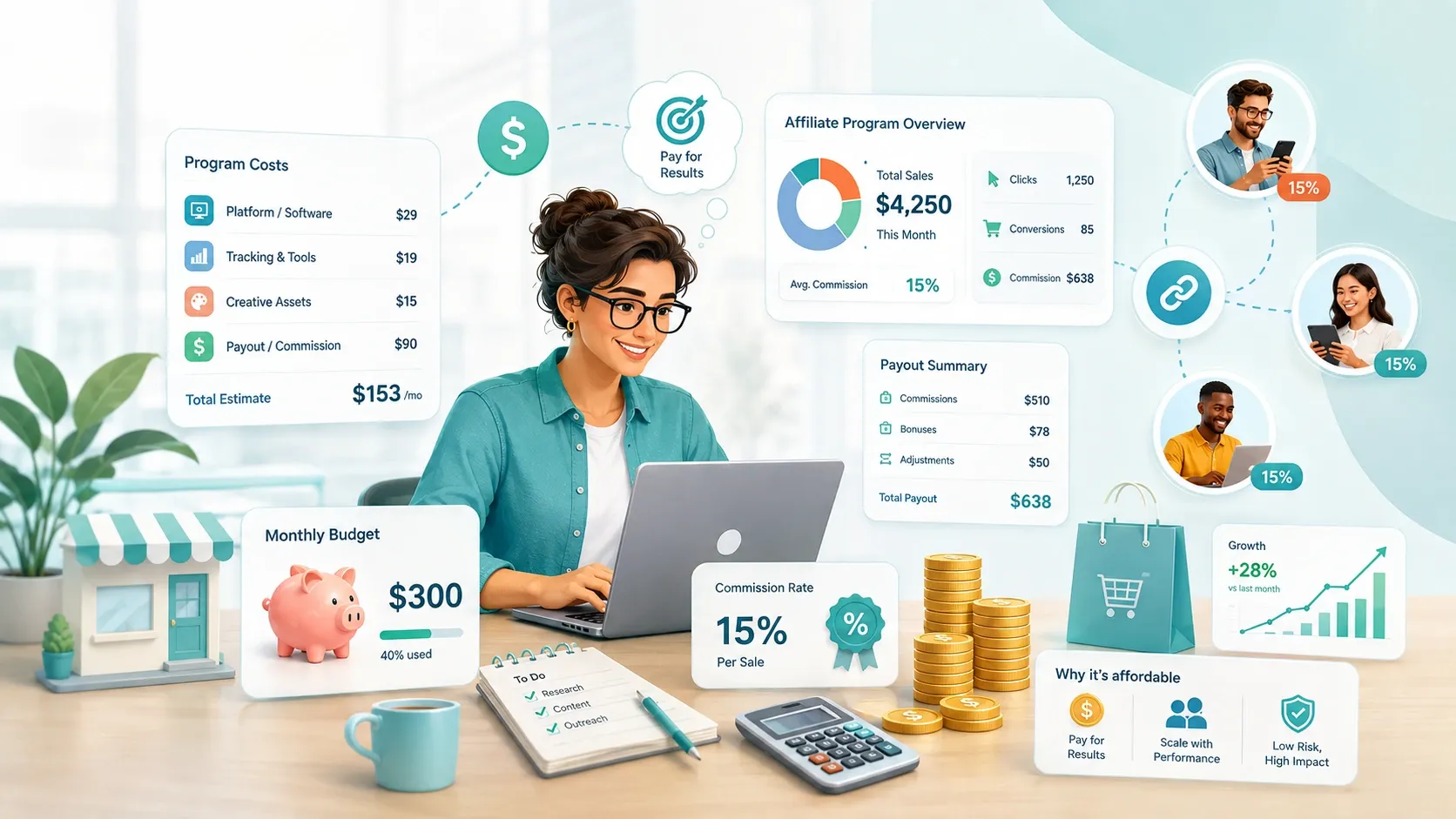
Less than most people expect. The commissions only come out of sales you have already made, so they are a cost of revenue, not an up-front bet. Your real fixed costs are the software and your time, and those change a lot depending on how you run the program.
Running it on your own site (self-hosted plugin). You keep every dollar of commission between you and your affiliate. A self-hosted plugin usually has a free version to start, and paid plans run roughly $50 to $300 for a one-time or yearly license. Nothing is skimmed off your sales. WC Affiliate, for example, is free to start and offers a one-time lifetime license, so the cost does not climb as you add affiliates.
Using an affiliate network. A network handles the tech and brings affiliates, but you pay for that access. Setup fees commonly run $500 to $2,000, monthly maintenance sits around $30 to $500, and the network takes a cut of 10% to 30% on top of every commission you pay. So a $150 commission can actually cost you $165 to $195 once the override is added.
The commissions themselves. These scale with sales, not with your budget. If you pay a 15% commission and an affiliate drives $1,000 in orders, that is $150 out of $1,000 you would not have earned otherwise. In the months they sell nothing, you pay nothing.
For a small business watching cash, owning the program on your own site is the cheaper path as you grow. You skip the setup fees, the monthly minimums, and the per-sale override, and you keep full control of who promotes you.
Common affiliate marketing mistakes small businesses make
Most programs that fail do not fail because of the idea. They fail on the execution. Watch for these.
- Setting the commission too low. A 3% commission on a $20 product is 60 cents. No serious affiliate will work for that. Pay enough to make promoting you worth their time.
- Recruiting and then going silent. Affiliates need occasional nudges, fresh creatives, and a reason to keep posting. A program you launch and ignore will fade in a month.
- Making people wait to get paid. Slow payouts are the fastest way to lose good affiliates. Pay on schedule, every time.
- Ignoring fraud. A few bad actors will try self-referrals or fake clicks. Keep an eye on unusual patterns and set rules that let you claw back commissions on refunded orders.
- No tracking on repeat behavior. If you only measure the first sale, you miss the affiliates who bring you loyal, repeat customers. Those are often your most valuable partners.
Stay compliant: disclosures and taxes
Two things keep you out of trouble.
- First, disclosures. In many regions, affiliates are legally required to tell their audience they earn a commission. Make this a rule in your agreement. It protects both of you, and it builds trust with buyers.
- Second, taxes. If you pay affiliates above certain thresholds, you may need to collect tax details and file paperwork (for example, a 1099 form in the US). Check the rules where you operate, and keep clean records of what you pay each affiliate.
Neither of these is complicated. They just need to be handled from day one, not patched on later.
The simple way to run an affiliate program on WooCommerce
If your store runs on WooCommerce, you do not need an external network or a separate platform. You can add a full affiliate program directly inside your store with a plugin like WC Affiliate.
WC Affiliate is built natively for WooCommerce, so it reads your existing orders and tracks affiliate sales without a workaround. The free version gives you a real program to start with: unlimited affiliates, a dashboard for you and one for each affiliate, flexible commission rules, real-time reporting, and email notifications. There is no cap on how many affiliates you can add, which matters as your program grows.
When you are ready for more, the Pro version adds multi-level commissions, coupon-based tracking, branded short links, a registration form and banner builder, and automatic payouts through PayPal, Stripe, Wise, and Payoneer. It runs on a lifetime license, so you pay once instead of an annual fee that climbs as you add affiliates.
For a small business, that pricing model is the point. You are not renting your affiliate program or paying a platform a slice of every commission. You own it, it lives on your own site, and it grows with you.
New to this? Our complete WooCommerce affiliate marketing guide walks through building and growing a profitable program, step by step.
Start small, then grow it
Affiliate marketing rewards small businesses that treat it like a real channel, not a side experiment. Set a clear goal, pay a fair commission, recruit people who genuinely like your product, and pay them on time. Do that, and you build a sales channel that costs you nothing until it earns.
If you sell on WooCommerce, the easiest way to begin is with a plugin that lives inside your store from day one. Try WC Affiliate and launch your first program this week. You can start with the free version, add your first affiliates, and only reach for the paid features once the sales are already rolling in.
Frequently Asked Questions
You can start for very little. Commissions only come out of sales you have already made. Beyond that, your main cost is affiliate software, and many self-hosted plugins offer a free version to begin with. You do not need a big budget to launch.
It depends on your margins. Physical products usually pay 5% to 15%. Digital products and courses often pay 20% to 40% because the margins are higher. The best rate is the highest one you can afford while still profiting on each sale.
Plan for a few months, not a few days. Recruiting quality affiliates and letting them build momentum takes time. Programs that are actively managed, with good payouts and fresh creatives, ramp faster than those left on autopilot.
No. You need a product people want to recommend and a fair commission. Your affiliates bring the audience. That is the whole point of the model.
They serve different jobs. Ads give you fast, controllable traffic, but you pay for it even when it does not convert. Affiliates cost you only when they drive a sale. Many small businesses run both, using affiliates as a lower-risk channel that scales with revenue.
Yes. A self-hosted plugin like WC Affiliate lets you run a full program on your own WooCommerce store with a free version to start and a one-time lifetime license for advanced features, so there is no recurring platform fee.